
Format Migration
This page describes how you can manage your data in Specto Preservation. After your digital files are submitted (See Submissions), Preservation Services run and any technical issues are handled (see Preservation), the files are moved for preservation to the Specto Preservation repository. You can search for and display these files and perform various actions on them.
Migrating Formats
With Specto Preservation, you can migrate digital files from one file format to another using the Migrate Format job. (See the Format Migration Options table for a list of the possible format migration options.) This is useful if you have determined that the current format of a file is likely to become obsolete.
- From the List of Jobs (Admin > Manage Jobs and Sets > Run a Job), select Migrate Format and select Next. The List of Sets page appears.
- Select the set with the files that you want to migrate and select Next. The Task Parameters page appears.
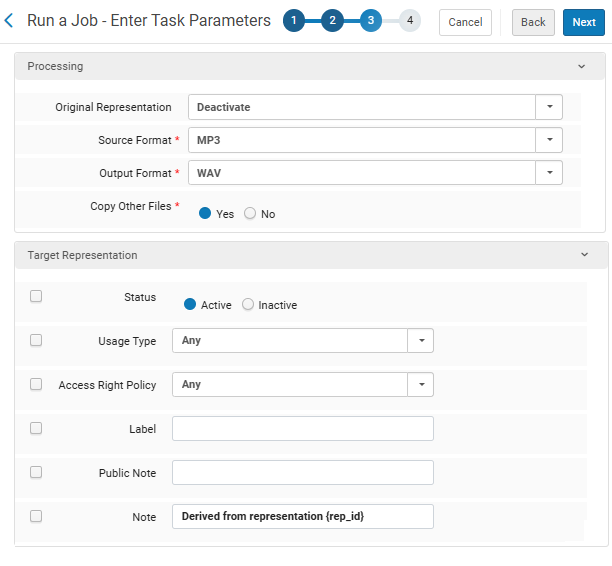 Migrate Formats Job Task Parameters
 - Fill in the fields of this page and select Next:
- Processing
- Original Representation – Select one of the following:
- Deactivate – the original representation will not be discoverable after the migration
- No Change – the original representation retains the existing activation status after the migration
- Source Format – select the original format of the digital files that you want to migrate
- Output Format – select the target format of the digital files that you want to migrate. The options available are determined by the source format you selected.
- Copy Other Files – select (Yes/No) if you want any other files in the original representation that are not being migrated to be included in the new representation
- Original Representation – Select one of the following:
- Target Representation
- Status – select (Active/Inactive) if you want the representation to be discoverable
- Usage Type – select one of the following usage types to assign to the representation:
- Primary – the original copy
- Modified Primary – a version that is changed from the primary but without any data loss
- Derivative – a secondary version, for example, a copy with a lower resolution
- Auxiliary – a representation that is supplementary to the main representation, for example, a table of contents
- Access Right Policy – select an access rights policy to assign to the representation
- Label – enter a label for the representation
- Public Note – enter a note that is visible to patrons
- Note – enter a note that is visible only to staff members
- Processing
The following table describes the available format migration options:
| Source Formats | Output Formats |
|---|---|
| MP3 | WAV |
| FLV | MP4 |
| TIFF |
|
| JP2 | JPG |
Compare with Original File
For files on which the Migrate Formats job was run, the Compare with Original action is available. Select this option to see a side-by-side comparison of the original file and the new file for you to compare visually:
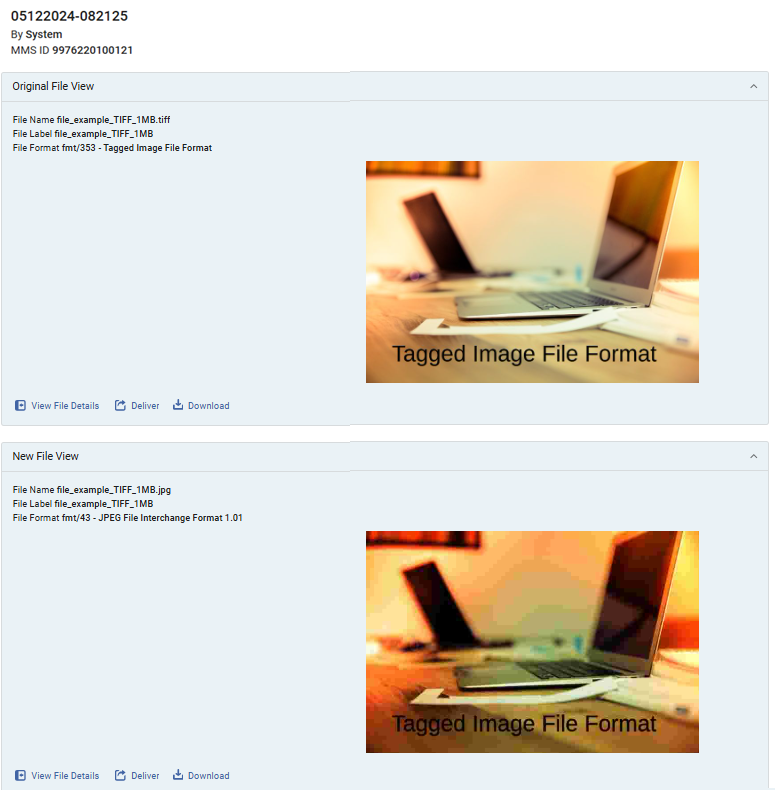
In addition, a table displaying a technical comparison between the details of the two files is displayed:
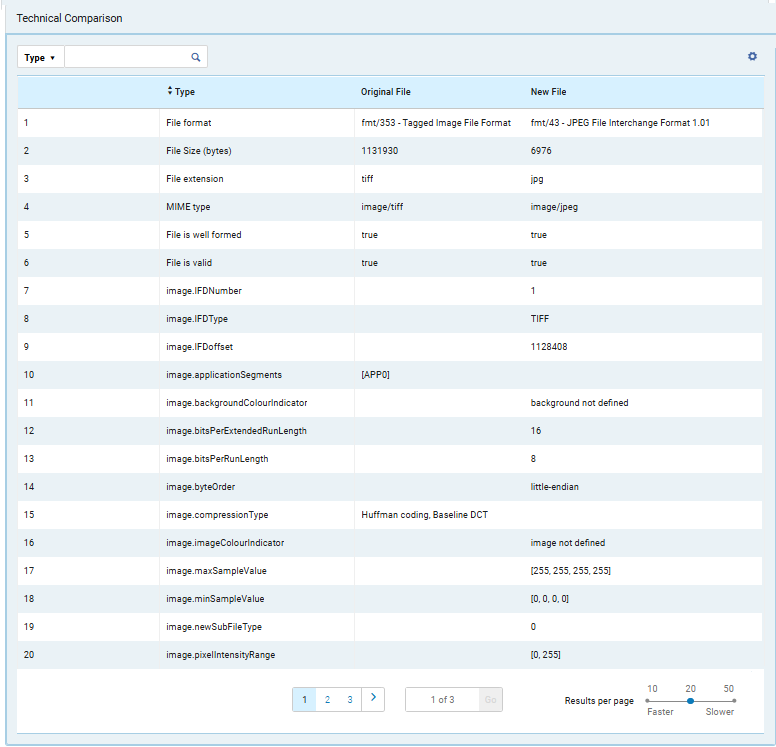
For each file, the View File Details,Deliver, and Download options are available.
Format Migration Options
| Source Format | Output Format |
|---|---|
| MP3 | WAV |
| FLV | MP4 |
| TIFF |
JPG JP2 |
| JP2 | JPG |
Page tags: article:topic content:Documentation product:rosetta lang:english
