Alma Subscription Licensing Model and Data Retainment
General
Contents of the Alma subscription and licensing model
The subscription model for Alma is based on the following subscription parameters:
- Number of unique e-journal titles
- Number of digital resources metadata
- This is relevant for institutions which manage digital resources in Alma, often referred to as "Alma D"
- Number of bibliographic titles (including e-books and local authority records)
- Number of Named Users
- This is the amount of users requiring login to Alma
- It is every user who has a role which is in addition to 'Patron" or "Instructor"
- Thus does not include the Ex Libris user exl_impl
- Size in GB for digital objects files
- This is relevant for institutions which manage digital resources in Alma, often referred to as "Alma D", and also store the digital objects in Alma's cloud storage
Directions to check specific amounts regarding the Alma Subscription
Calculate Number of Unique E-Journals:
To calculate the number of unique e-journals, use the advanced staff search to search for Electronic Titles where the portfiolio's “Material Type = Journal”.
Make sure you are searching your Institution Zone (and not the Network Zone or Community Zone).
The Number of Unique E-Journals is the number retrieved with the above query.
In the example below the amount is 140,549


Calculate Number of Digital Resources:
To calculate the number of digital resources use the staff search to search for Digital Titles where MMS ID > 0.
Make sure you are searching your Institution Zone (and not the Network Zone or Community Zone).
The Number of Digital Resources is the number retrieved with the above query.
In the example below the amount is 233,803


Calculate Number of Bibliographic Titles:
Preliminary Note: This calculation includes all titles. The subscription parameter is calculated to exclude unique e-journals and digital resources. Number of bibliographic titles = All titles - unique e-journal - digital resources
Preliminary Note: BIBFRAME Instance is included in the total titles count, and there is no change in pricing if this format is activated.
Step 1: Go to advanced Repository search. Search all titles according to MMS ID > 0. Make sure you are searching your Institution Zone. See screenshots below:
Below the number of "All Titles" is 2,399,625

 Step 2: Search the authorities using the same query. Also make sure you are searching the Institution Zone:
Below the number of authorities is 70,385


Step 3: Add the All Titles number and Institution Zone Authorities number together. Subtract from it unique e-journals and digital resources.
(all titles + Institution Zone Authorities) - (unique e-journals + digital resources).
In our example, the number of bibliographic titles is 2,095,658:
(2,399,625 + 70,385) - (233,803 + 140,549) =2,095,658
If you subscribe to the 'ProQuest Ebooks' collection (Collection ID: 61612569610000041) the bibliographic records of this collection should not be included in the count.
Therefore, deduct its total number of records (751,032 as of March 10, 2025) from your above record count.
Calculate the Number of Named Users
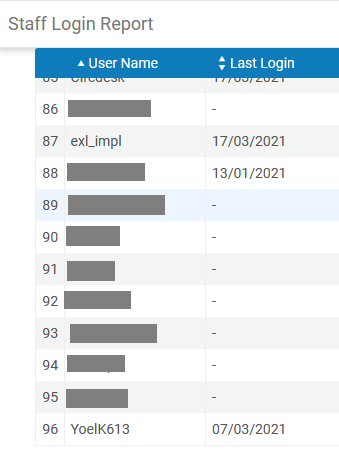
The Staff Login Report displays a list of staff users.
The report lists all staff accounts. Some of them have a date next to them while others do not. The ones without a date have not logged in to Alma in the previous 90 days.
To get the actual number, scroll down to the end of the list. This number is the number of staff users managed in the system.
NOTE: If the user exl_impl (the Ex Libris account used by implementation and support staff) is included here it can be subtracted from the total count (subtract 1 from the total count).
In the example below, the number of named users is 95.
There are 96 named users, but row 87 is exl_impl so it needs to be subtracted.
Calculate the Size in GB for digital objects files
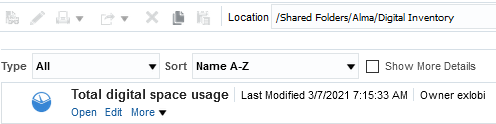
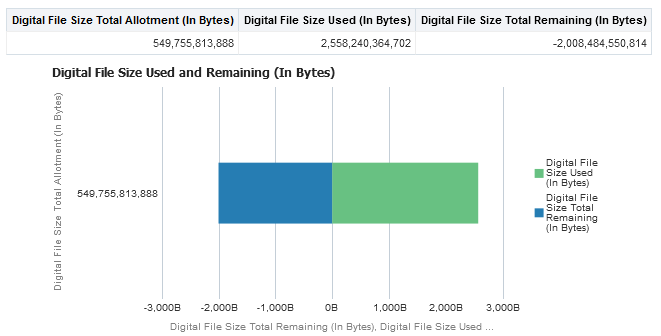
In Alma Analytics open the report ‘Total Digital Space Usage' which is located in folder ‘/Shared/Alma/Digital/Inventory'
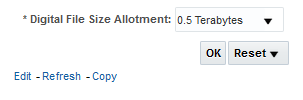
From the prompt select your current storage allocation per your subscription, for example 0.5 TB, and click OK
View the "Digital Files Size Used" and "Digital File Size Total Remaining".
Functional components of the Alma subscription
-
Acquisitions (including serials and license management)
-
Fulfillment (including circulation, resource sharing, reserves, and booking)
-
Metadata Management (including e-resource management)
-
Administration
-
Link Resolution (including an A-Z journal title search which displays in Primo)
-
Knowledgebase (including authority control)
-
Analytics (reporting)
-
Developers Network (including APIs and other integration mechanisms)
Is your licensing model role based or staff based?
One named user (one staff user login) can be assigned multiple roles in different library locations. There are no restrictions regarding the number of “roles” each “user login” can have.
How is a login reallocated when staff leave the library?
Ex Libris doesn't lock the system using “license key” – we audit the system twice a year and measure the number of named users and send a query to the customer in case the actual number of named users in the system is over the subscription limit. In general, a named user may be deleted from the system and a new one created without affecting the threshold and without any intervention required by Ex Libris. Audit trail for user logins is available in the system and could be used by the university.
Are there any cost implications if usage of Alma results in increase in usage of RAM, CPU, etc.?
Costs are based on subscription parameters. Ex Libris does not charge for RAM/CPU usage. Only increase in required subscription parameters will result in ian ncrease in subscription fees.
Is there a cost for interfacing with additional products?
Ex Libris does not charge fee for interfacing Alma with 3rdparty products – all interfaces and APIs are included in the standard subscription fee and don't required a special fee or subscription. Please note that usage of the Alma APIs is governed by governance thresholds to maintain optimum performance and ensure that infrastructure resources are not disproportionately used by a single institution impacting other Alma institutions.
What is the expected lifespan of Alma?
Ex Libris develops, implements and supports library management solutions for over 25 years and is recognized as a market leader. Ex Libris has today over 5,500 customers worldwide using our products. Ex Libris Alma is our next generation library management solution and we consider Alma a major and key product in our portfolio and is a key product in the continuous growth of the company.
As a next generation solution, the product has an active development plan for many years ahead. In addition, looking at Ex Libris' track record of continuous development and support for our previous ILS generation Aleph and Voyager, customers can be assured of Ex Libris' plans to invest in Alma and have many years of active developments in our next generation library management solution. As long as a customer is subscribed to Alma, the subscription fee includes support for the solution.
Digital Resource Management
What are the licensing requirements for managing digital resources in Alma?
See:Licensing Requirements in Digital Resource Management.
Data retainment
What is done with a customer's data if a subscription is terminated?
The customer is in full control of the data stored through the SaaS service and has responsibility to determine the retention scheme for the customer data. The Ex Libris contract specifies that customer data will be available in industry-standard format for download upon termination or completion of the service (free of charge). The customer will have 30 days to download the data before Ex Libris will delete it. Upon request, Ex Libris will provide certification that the data deletion contract has ended, and that customer data is deleted permanently within the Ex Libris environment.
In what format would a customer get its data back when a subscription is terminated?
The Ex Libris contract specifies that customer data will be available in industry-standard format for download upon termination or completion of the service (free of charge). The customer will have 30 days to download the data before Ex Libris will delete it.
Would the customer be able to extract and retain copies of data that originated in the CZ?
Data in the Community Zone is offered to all Alma customers with no restrictions on its use or reuse. All Alma users may export any or all bibliographic records linked to their inventory whether in the Community Zone or local catalogs. Ex Libris makes no claims of ownership on these records.
Total views:
Page tags: article:topicproduct:almacontent:Documentationlang:english
