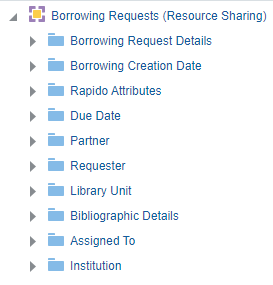
Borrowing Requests (Resource Sharing)
Create reports/dashboards for the Borrowing Requests area.
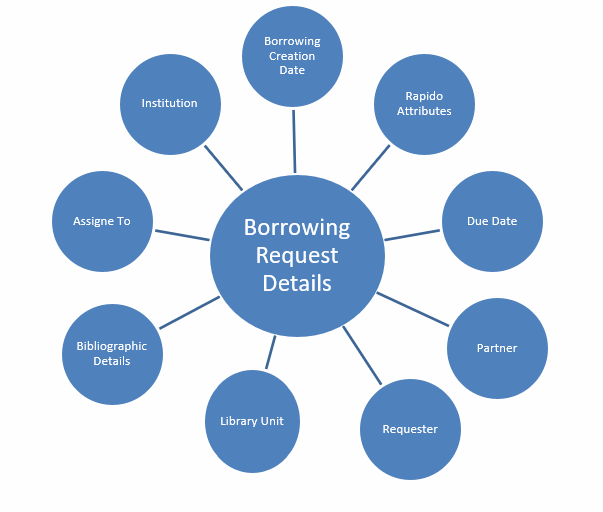
Using the Borrowing Requests (Resource Sharing) area, the Design Analytics user can create reports/dashboards for the Borrowing Requests (Resource Sharing) area and is able to answer the following types of business questions:
- Which partners were requested
- Request counts
- Which type of users issue the requests
- Time statistics between request and arrival
- How many requests were rejected
- How many requests were completed
Field Descriptions
The following lists the fields available in Borrowing Requests.
Borrowing Request Details
The Borrowing Requests table is a fact table that displays all measures relating to specific borrowing requests from a specific partner. This table also holds details about the borrowing requests, including request status, request format, and locate status. The primary keys are ID and PARTNER_ID.
| Field | Description | Field Location in Alm | Additional Information | Data Type | Data Size |
|---|---|---|---|---|---|
| Request Level Measurements | |||||
| Num of Requests | Holds the number of patron borrowing requests | This includes the number of requests from all potential partners in the Rota | |||
| Num of Requests Filled | Holds the number of requests that have a receiving date | ||||
| Number of Request Renewals | Holds the number of request renewals | ||||
| Num of Request Renewal Rejections | Holds the number of request renewal rejections | ||||
| Num of General Messages | Holds the number of general messages | ||||
| Num of Locate Failed Requests | The number of failed locate requests | Includes data for requests that were created from May 2021 and later | |||
| Num of Unique Titles | The number of unique titles (mms ids) associated to a Borrowing Request | INT | |||
| Partner Level Measurements | |||||
| Num of Partners in Rota (Total) | Holds the total number of partners in the Rota | ||||
| Num of Partners in Rota (Consulted) | Holds the number of consulted partners in the Rota | ||||
| Num of Active Partner Requests | Holds the number of borrowing requests whose Partner Active Status is set to Active | ||||
| Num of Digital Accesses | Holds how many requested digital files were actually accessed by patrons | ||||
| Num of Non Fulfilled Partner Requests | Holds the number of borrowing requests whose Partner Active Status is set to Reject (indicates that the request to this partner cannot be fulfilled) | ||||
| Num of Canceled Partner Requests | Holds the number of canceled partner requests | ||||
| Num of Expired Partner Requests | Holds the number of expired partner requests | ||||
| Num of Rapid Local Override | The number of times librarians overrode the RapidIILL block for borrowing requests when the borrowing library has the requested item locally. | ||||
| Days of Request for Partner | Holds the number of days of request for partner. The time begins when the request is sent to the partner and ends when the request is either sent to a different partner or is completed. | The Day value is the number of complete days. If the value is composed of several time periods, the sum of the values is considered. | |||
| Days of Request to Material Arrival | Number of days from when the request was created until the material arrived | The Day value is the number of complete days. If the value is composed of several time periods, the sum of the values is considered. | |||
| Days of Request Sent to Material Arrival | Number of days from when the request was sent to the partner until the material arrived | The Day value is the number of complete days. If the value is composed of several time periods, the sum of the values is considered. | |||
| Days of Request Sent to Non-Fulfilled | Number of days past from when the request was sent to the partner until it was rejected (non-fulfilled) | The Day value is the number of complete days. If the value is composed of several time periods, the sum of the values is considered. | |||
| Days of Arrival to Patron Loan | Number of days from when the material arrived until the patron loaned the item | The Day value is the number of complete days. If the value is composed of several time periods, the sum of the values is considered. | |||
| Days of Patron Check-In to Return | Number of days from when the patron checked in the item until it was returned to the ILL library | The Day value is the number of complete days. If the value is composed of several time periods, the sum of the values is considered. | |||
| Hours of Request for Partner | Holds the number of hours of request for partner. The time begins when the request is sent to the partner and ends when the request is either sent to a different partner or is completed. | The Hour value is the number of complete hours. If the value is composed of several time periods, the sum of the values is considered. | |||
| Hours of Request to Material Arrival | Number of hours from when the request was created until the material arrived | The Hour value is the number of complete hours. If the value is composed of several time periods, the sum of the values is considered. | |||
| Hours of Request Sent to Material Arrival | Number of hours from when the request was sent to the partner until the material arrived | The Hour value is the number of complete hours. If the value is composed of several time periods, the sum of the values is considered. | |||
| Hours of Request Sent to Non-Fulfilled | Number of hours past from when the request was sent to the partner until it was rejected (non-fulfilled) | The Hour value is the number of complete hours. If the value is composed of several time periods, the sum of the values is considered. | |||
| Hours of Arrival to Patron Loan | Number of hours from when the material arrived until the patron loaned the item | The Hour value is the number of complete hours. If the value is composed of several time periods, the sum of the values is considered. | |||
| Hours of Patron Check-In to Return | Number of hours from when the patron checked in the item until it was returned to the ILL library | The Hour value is the number of complete hours. If the value is composed of several time periods, the sum of the values is considered. | |||
| Minutes of Request for Partner | Holds the number of minutes of request for partner. The time begins when the request is sent to the partner and ends when the request is either sent to a different partner or is completed. | The Minute value is the number of complete minutes. If the value is composed of several time periods, the sum of the values is considered. | |||
| Minutes of Request to Material Arrival | Number of minutes from when the request was created until the material arrived | The Minute value is the number of complete minutes. If the value is composed of several time periods, the sum of the values is considered. | |||
| Minutes of Request Sent to Material Arrival | Number of minutes from when the request was sent to the partner until the material arrived | The Minute value is the number of complete minutes. If the value is composed of several time periods, the sum of the values is considered. | |||
| Minutes of Request Sent to Non-Fulfilled | Number of minutes past from when the request was sent to the partner until it was rejected (non-fulfilled) | The Minute value is the number of complete minutes. If the value is composed of several time periods, the sum of the values is considered. | |||
| Minutes of Arrival to Patron Loan | Number of minutes from when the material arrived until the patron loaned the item | The Minute value is the number of complete minutes. If the value is composed of several time periods, the sum of the values is considered. | |||
| Minutes of Patron Check-In to Return | Number of minutes from when the patron checked in the item until it was returned to the ILL library | The Minute value is the number of complete minutes. If the value is composed of several time periods, the sum of the values is considered. | |||
| Additional Information | The text of the additional information received from the borrower. | Borrowing Requests task list > Right Pane > Request Attributes section | VARCHAR2 | 255 CHAR | |
| Agree Copyright | Indicates whether the patron has checked the Agree Copyright check box | See the field location in Alma in the figure Borrowing Requests - Edit, below. | |||
| Creator | The creation date | ||||
| Modification Date | The date when the user modified the record | ||||
| Modification Date (Calendar) | The date without a timestamp when the user modified the record | ||||
| Modified By | The name of the user that modified the record | ||||
| Title | The title of the record | ||||
| Additional Notes | The additional notes added under the Notes tab of the Resource Sharing Borrowing Requests page | ||||
| Citation Type | Indicates whether the resource is an article or book | ||||
| Base Fee Amount | The baseline fee that the lender charges per request. | ||||
| BL Customer ID | Holds the customer code and password of the British Library system | ||||
| BL Requested Actions | British Library codes for other instructions for queries | ||||
| BL Request Targets | British Library codes for where to search for the material | ||||
| BL Requested Delivery Terms | British Library codes for the delivery format and speed | ||||
| New for September! Borrowing Request Label | Displays the labels associated with the borrowing request. | When multiple labels are assigned, the label values are concatenated together with a semicolon (;). | VARCHAR | 4000 | |
| Borrowing Request Status | Holds the status of the request | See the field location in Alma in the figure Borrowing Requests - Edit, below. | |||
| Cancellation Reason | The cancellation reason of the borrowing request | This enables you to follow trends and understand why requests are being cancelled. | |||
| Chapter Number | The chapter number of the borrowing request | ||||
| Chapter Title | The chapter title of the borrowing request | ||||
| Copyright Fee Amount | The copyright cost assigned to the request. | ||||
| Copyright Status | The copyright approval status | ||||
| Digital Resource First Access Date | The date and time that the digital resource was first accessed | ||||
| Digital Resource First Access Date (Calendar) | The date without a timestamp that the digital resource was first accessed | ||||
| eBook Indicator | Indicates (Yes/No) if the resource is an eBook. | ||||
| External Identifier | The ID of the library that fulfills the borrowing request | See the field location in Alma in the figure Borrowing Requests - Edit, below. | |||
| Fulfillment Request ID | Hold Request ID | ||||
| Identifier | Holds the ISSN/ISBN of the requested resource | ||||
| Internal ID | Holds the Unique ID of the borrowing request | See the field location in Alma in the figure Borrowing Requests - Edit, below. | |||
| Is Filled | Indicates if the borrowing request was filled | ||||
| Issue | The issue of the borrowing request | ||||
| Item Arrival Date | Holds the date that the material arrived to the library | ||||
| Item Arrival Date (Calendar) | Holds the date without a timestamp that the material arrived to the library | ||||
| Item Check-In Date | Holds the date that the item was returned to the library by the patron | ||||
| Item Check-In Date (Calendar) | Holds the date without a timestamp that the item was returned to the library by the patron | ||||
| Item ID | Holds the Item ID of the borrowing resource | ||||
| Item Return Date | Holds the date that the item was returned to the ILL | ||||
| Item Return Date (Calendar) | Holds the date without a timestamp that the item was returned to the ILL | ||||
| Item Loan Date | Holds the date that the material was loaned by the patron | ||||
| Item Loan Date (Calendar) | Holds the date without a timestamp that the material was loaned by the patron | ||||
| Item Loan ID | Holds the item loan ID after the item was loaned | If multiple items were received for the borrowing request and loaned to the patron, the Item Loan ID will not be populated. | |||
| Item Loan Indicator | Indicates whether the requested resource was loaned | ||||
| Journal Title | The title of the journal of the borrowing request | ||||
| Label | The labels on the borrowing request | ||||
| Label History | The deleted labels on the borrowing request | ||||
| Level of Service | The level of service of the borrowing request | ||||
| Lending Institution | The lending institution | ||||
| Lending Library | The lending library | ||||
| Locate Status | Indicates whether the resource is located or not | ||||
| Lost Item Fee Amount | The mount of the lost item fee | ||||
| Lost Item Fee Currency | The currency of the lost item fee | ||||
| Lost Item Fee VAT | The VAT of the lost item fee | ||||
| Max Fee | Holds the maximum fee that the patron is willing to pay for this service | See the field location in Alma in the figure Borrowing Requests - Edit, below. | |||
| Needed by Date | Holds the date by which this material is needed | See the field location in Alma in the figure Borrowing Requests - Edit, below. | |||
| Needed by Date (Calendar) | Holds the date without a timestamp by which this material is needed | See the field location in Alma in the figure Borrowing Requests - Edit, below. | |||
| Note | A text field for comments | See the field location in Alma in the figure Borrowing Requests - Edit, below. | |||
| Page Overage Fee Amount | The fee that is assigned when the requested page count is greater than the page count included in the base fee. | ||||
| Pages | The pages of the borrowing request | ||||
| Partner Active Status | The status of a partner on a specific request Rota | Possible values are Active/Rejected/Non-Active/Cancelled/Expired. | |||
| Patron Information Indicator | Indicates whether more information is needed from the patron | ||||
| Request Completed Indicator | Indicates whether the lifecycle of the request is in progress or it is completed | ||||
| Requested Format | Indicates the format of the request (Digital/Physical) | See the field location in Alma in the figure Borrowing Requests - Edit, below. | |||
| Request Non-Fulfilled Date | Holds the date that the request was rejected for this partner | ||||
| Request Non-Fulfilled Date (Calendar) | Holds the date without a timestamp that the request was rejected for this partner | ||||
| Request Sending Date | Holds the date that the request was sent to the partner | ||||
| Request Type | The request format and the request type | ||||
| Request Sending Date (Calendar) | Holds the date without a timestamp that the request was sent to the partner | ||||
| Rialto Status | The status of the item purchased in Rialto. |
Possible values:
|
|||
| Service Level Fee Amount | The fee that the lender charges per the service level assigned to the request. The service level is provided by the borrowing institution in the request information. | ||||
| Shipping Cost | The shipping cost. | See the field location in Alma in the figure Borrowing Requests - Edit, below. | |||
| Shipping Cost Currency | The currency of the shipping cost. | See the field location in Alma in the figure Borrowing Requests - Edit, below. | |||
| Shipping Date | The date and time the lender shipped the item to the borrower. | Date fields can consist of a partial date, such as just the year or a month and year. | |||
| Shipping Date (Calendar) | The date the lender shipped the item to the borrower. | Calendar Date fields always consist of a month, date, and year. If the information is not provided, 01 is added, so that a date of 2020 is rendered 01/01/2020. This date format is useful when filtering the report by date. | |||
| Supplied Format | The format in which the borrowing request was supplied to the patron | Possible values: Physical or Digital | |||
| Tracking Number | Populated by the free text field available for recording values in the borrowing requests. | In the Borrowing task list side panel. | VARCHAR2 | 255 | |
| Vat Fee Amount | Populated from the VAT Fee Field, which is populated manually or as defined by the Lender Shipping Cost Rules. | In the Borrowing task list side panel. | NUMBER | 19,2 | |
| Volume | The volume of the borrowing request | ||||
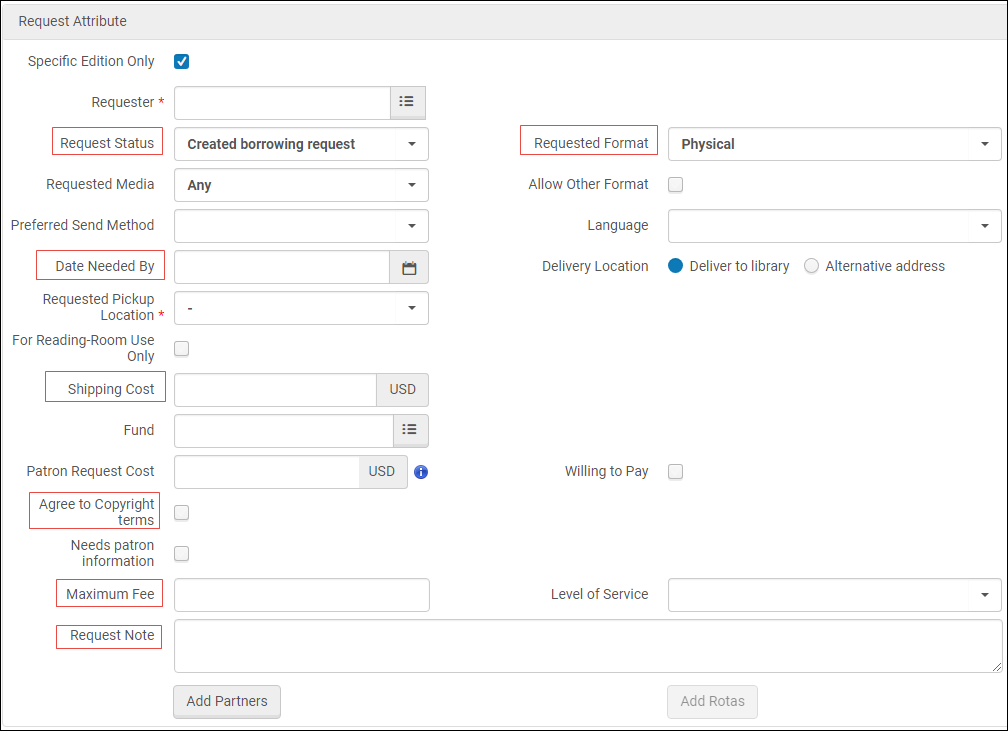
The following diagram shows some of the borrowing request field locations in Alma.
Borrowing Creation Date
The Creation Date table is a dimension table that displays details about the borrowing request creation date. Key fields are used whenever calculations are required. Description fields may be used for formatting the display of the report. Alma displays the following types of fields:
- Calendar Fields– These are date fields that are displayed in the calendar.
- Fiscal Date Fields– These are date fields that match the institution's fiscal period. In the examples below, the fiscal period of the institution is for fiscal year 2012 that starts June 1, 2011 and ends May 31, 2012.
Using this dimension, the user may drill down from year to month to the specific date on which the borrowing request was created. The total number of borrowing requests is listed next to the relevant level in the hierarchy.
| Field | Description | Additional Information | Data Type | Data Size |
|---|---|---|---|---|
| Borrowing Creation Date and Time | The current course end date and time of the Borrowing. | The date in the format DD/MM/YYYY HH:SS:MM AP/PM | DATETIME | |
| Borrowing Creation Date | The current course end date of the Borrowing. | The date in the format DD/MM/YYYY | DATE | |
| Borrowing Creation Start of Week | The date of the first business day of the week. | The date in the format DD/MM/YYYY | DATE | |
| Borrowing Creation Week Number | The number of the week of the year. | There are 52 weeks in a year. | VARCHAR | 2 |
| Borrowing Creation Month Key | The month of the date in number format. | For example - February will show the number 2 in this column. This field is useful when you want to sort by month. | INT | |
| Borrowing Creation Month | The month of the date in text format. | The month, for example, "February". | VARCHAR | 20 |
| Borrowing Creation Full Month | The year and month that the Borrowing was modified. | The month in text format and the year. For example - Feb 25 (for February 2025). | VARCHAR | 20 |
| Borrowing Creation Quarter | The quarter in the year in which the Borrowing was modified. | The quarter of the date in a display format such as Q1. | VARCHAR | 20 |
| Borrowing Creation Year | The year in which the Borrowing was modified. | The year of the date in the format YYYY. For example - 2025. | VARCHAR | 20 |
| Borrowing Creation Year-Month | The year and the month in which the Borrowing was modified. | The year and the month in the format YYYY-MM. | VARCHAR | 250 |
| Borrowing Creation Fiscal Month Key | The fiscal month of the date in number format. | For example - If the fiscal year starts in June, this column will show the number 1 for June, the number 2 for July, and so on. | INT | |
| Borrowing Creation Fiscal Year | The fiscal year of the date in string format. | The year is presented according to the description in the mapping table "Fund and Ledger Fiscal Period". For more information, see Configuring Fund and Ledger Fiscal Periods. | VARCHAR | 50 |
| Borrowing Creation Date Filter | Used to filter report results by date. |
Possible values:
|
VARCHAR | 100 |
| Borrowing Creation Date | The date in a hierarchy format. | Enables the user to drill down from the year to the month to the specific date. Using this column provides the user with the option to view the accumulative measures in each level of the hierarchy. |
Rapido Attributes
| Field | Description | Additional Information | Data Type | Data Size |
|---|---|---|---|---|
| Rapido Automatic Renewals Allowed | Indicates if automatic renewals of the borrowing request are allowed | VARCHAR | 15 | |
| Rapido Cancelled by Mediation | Indicates (Y/N) whether the borrowing request was cancelled during staff mediation | VARCHAR | 5 | |
| Rapido Expire Time (in days) | The number of days until the borrowing request expires | INT | ||
| Rapido Fill Locally | Indicates if the borrowing request is filled locally |
Possible values:
|
VARCHAR | 15 |
| Rapido Indicator | Indicates if the request originated from Rapido. | The value is Yes if the request is automatically sent by Rapido to a Rapido partner from a Rapido pod. | CHAR | 3 |
| Rapido Label | The Rapido label | VARCHAR | 2000 | |
| Rapido Label History | The Rapido label history | VARCHAR | 2000 | |
| Rapido Manual Request | VARCHAR | 3 | ||
| Rapido Number of Renewals | The number of times the borrowing request was renewed | INT | ||
| Rapido Pod Delivery Time (in days) | The Rapido Pod delivery time (in days) | DOUBLE | ||
| Rapido Pod Delivery Time (in hours) | The Rapido Pod delivery time (in hours) | DOUBLE | ||
| Rapido Pod ID | The Rapido Pod ID to which the request is linked. | VARCHAR | 30 | |
| Rapido Pod Loan Period | The Rapido Pod loan period | DOUBLE | ||
| Rapido Pod Name | The Rapido Pod name | VARCHAR | 255 | |
| Rapido Pod Shipping Cost | The Rapido Pod shipping cost | DOUBLE | ||
| Rapido Source of Request | The source of the Rapido borrowing request |
Possible values are:
|
VARCHAR | 255 |
Due Date
The Due Date table is a dimension table that displays the date that the lending library wants the item to be returned to it by the borrowing library. The primary key is Date_Key.
| Field | Description | Additional Information | Data Type | Data Size |
|---|---|---|---|---|
| Due Date | The due date of the purchase request | The date in the format DD/MM/YYYY | DATE | |
| Due Start of Week | The date of the first business day of the week | The date in the format DD/MM/YYYY | DATE | |
| Due Week Number | The number of the week of the year | There are 52 weeks in a year. | VARCHAR | 2 |
| Due Month Key | The month of the date in number format | For example - February will show the number 2 in this column. This field is useful when you want to sort by month. | INT | |
| Due Month | The month of the date in text format | The month, for example,"February" | VARCHAR | 20 |
| Due Full Month | The year and month that the purchase request was modified | The month in text format and the year. For example - Feb 25 (for February 2025) | VARCHAR | 20 |
| Due Quarter | The quarter in the year in which the purchase request was modified | The quarter of the date in a display format such as Q1 | VARCHAR | 20 |
| Due Year | The year in which the purchase request was modified | The year of the date in YYYY format. For example - 2025 | VARCHAR | 20 |
| Due Fiscal Month Key | The fiscal month of the date in number format | For example - If the fiscal year starts in June, this column will show the number 1 for June, the number 2 for July, and so on. | INT | |
| Due Fiscal Year | The fiscal year of the date in string format | The year is presented according to the description in the mapping table "Fund and Ledger Fiscal Period". See Configuring Fund and Ledger Fiscal Periods. | VARCHAR | 50 |
| Due Date Filter | Used to filter report results by date | Possible values: Current Academic Year, Current Fiscal Year, Current Month, Current Year, Last 3 Months, Last 30 Days, Last 365 Days, Last 7 Days, Older than 30 Days, Older than 60 Days, Older than 7 Days, Older than 90 Days, Previous Complete 12 Months, Previous Complete 24 Months, Previous Complete Two Years, Previous Fiscal Year, Previous Month, Previous Year, Two Fiscal Years Ago, and Two Years Ago. | VARCHAR | 100 |
| Due Year-Month | The year and the month in which the purchase request was modified | The year and the month in the format YYYY-MM | VARCHAR | 250 |
| Due Date | The date in a hierarchy format | Enables the user to drill down from the year to the month to the specific date. Using this column provides the user with the option to view the accumulative measures in each level of the hierarchy. |
Loan Due Date
The Loan Due Date table is a dimension table that displays the date that the patron must return the item to the borrowing library. The primary key is Date_Key.
| Field | Description | Additional Information | Data Type | Data Size |
|---|---|---|---|---|
| Loan Due Date | The loan due date of the purchase request | The date in the format DD/MM/YYYY | DATE | |
| Loan Due Start of Week | The date of the first business day of the week | The date in the format DD/MM/YYYY | DATE | |
| Loan Due Week Number | The number of the week of the year | There are 52 weeks in a year. | VARCHAR | 2 |
| Loan Due Month Key | The month of the date in number format | For example - February will show the number 2 in this column. This field is useful when you want to sort by month. | INT | |
| Loan Due Month | The month of the date in text format | The month, for example,"February" | VARCHAR | 20 |
| Loan Due Full Month | The year and month that the purchase request was modified | The month in text format and the year. For example - Feb 25 (for February 2025) | VARCHAR | 20 |
| Loan Due Quarter | The quarter in the year in which the purchase request was modified | The quarter of the date in a display format such as Q1 | VARCHAR | 20 |
| Loan Due Year | The year in which the purchase request was modified | The year of the date in YYYY format. For example - 2025 | VARCHAR | 20 |
| Loan Due Fiscal Month Key | The fiscal month of the date in number format | For example - If the fiscal year starts in June, this column will show the number 1 for June, the number 2 for July, and so on. | INT | |
| Loan Due Fiscal Year | The fiscal year of the date in string format | The year is presented according to the description in the mapping table "Fund and Ledger Fiscal Period". See Configuring Fund and Ledger Fiscal Periods. | VARCHAR | 50 |
| Loan Due Date Filter | Used to filter report results by date | Possible values: Current Academic Year, Current Fiscal Year, Current Month, Current Year, Last 3 Months, Last 30 Days, Last 365 Days, Last 7 Days, Older than 30 Days, Older than 60 Days, Older than 7 Days, Older than 90 Days, Previous Complete 12 Months, Previous Complete 24 Months, Previous Complete Two Years, Previous Fiscal Year, Previous Month, Previous Year, Two Fiscal Years Ago, and Two Years Ago. | VARCHAR | 100 |
| Loan Due Year-Month | The year and the month in which the purchase request was modified | The year and the month in the format YYYY-MM | VARCHAR | 250 |
| Loan Due Date | The date in a hierarchy format | Enables the user to drill down from the year to the month to the specific date. Using this column provides the user with the option to view the accumulative measures in each level of the hierarchy. |
Partner
The Partner table is a dimension table that displays the details about the partner to which the borrowing request was sent. The primary key of the table is PARTNER_ID.
| Field | Description | Additional Information | Data Type | Data Size |
|---|---|---|---|---|
| Account Allowances | Define the uses the partner is allowed to make with the supplied material. Multiple values are allowed in this field, separated by semicolons (;) | VARCHAR | 4000 | |
| Alternate Account Number | Partner alternate account number | VARCHAR | 255 | |
| Alternate Symbol | The alternate symbol of the institution | VARCHAR | 255 | |
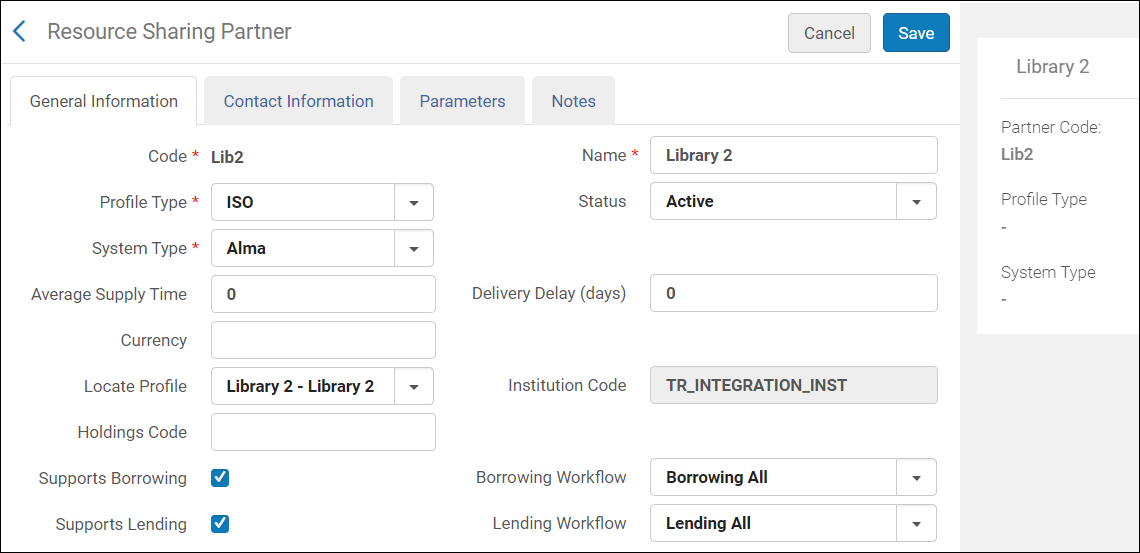
| Average Supply Time | Average time it takes for the supplier to process the request and send the material | See the field location in Alma in the figure Borrowing Requests - Partners, below. | DOUBLE | |
| Billing Address Line1 | Line 1 of the billing address | These fields are relevant for Rapido | VARCHAR | 1000 |
| Billing Address Line2 | Line 2 of the billing address | VARCHAR | 1000 | |
| Billing City | The billing city | VARCHAR | 255 | |
| Billing Contact Email | The billing contact email | VARCHAR | 1000 | |
| Billing Contact Name | The billing contact name | VARCHAR | 255 | |
| Billing Country | The billing country | VARCHAR | 4000 | |
| Billing Postal Code | The billing postal code | VARCHAR | 255 | |
| Billing State Province | The billing state or province | VARCHAR | 320 | |
| Copyright Payment Responsibility | Whether the borrower or lender is responsible for the copyright payment | VARCHAR | 255 | |
| Creation Date | The date the request was created | DATE | ||
| Creator | The name of the user that created the request | |||
| Currency | Holds the currency that this partner is using | See the field location in Alma in the figure Borrowing Requests - Partners, below. | VARCHAR | 255 |
| Delivery Delay | Average time it takes to send an item back to this supplier | See the field location in Alma in the figure Borrowing Requests - Partners, below. | VARCHAR | 255 |
| Direct Charge Indicator | Indicates if the Enable Direct Charge Functionality checkbox is selected, which enables you to set whether the borrowing or lending partner is responsible for the Copyright Payment when payments apply. | For more information, see Configuring Copyright Billing Settings. | VARCHAR | 5 |
| Maximum Request Cost | The maximum cost the requesting partner accepts without additional approval. | DOUBLE | ||
| Modification Date | The user name that modified the record | DATE | ||
| Modified By | The modification date | VARCHAR | 255 | |
| Organization Type | The partner organization type | VARCHAR | 255 | |
| Partner Code | Holds the partner code | See the field location in Alma in the figure Borrowing Requests - Partners, below. | VARCHAR | 255 |
| Partner Deleted Status | Indicates if the partner was deleted. | VARCHAR | 5 | |
| Partner Description (to be deprecated) | VARCHAR | 255 | ||
| Partner ID | Holds the unique partner ID | VARCHAR | 50 | |
| Partner Institution | The institution of the partner | VARCHAR | 255 | |
| Partner Name | Holds the partner name | See the field location in Alma in the figure Borrowing Requests - Partners, below. | VARCHAR | 4000 |
| Partner Status | Holds the partner status (Active/Reject/Non Active) | See the field location in Alma in the figure Borrowing Requests - Partners, below. | VARCHAR | 255 |
| Partner System Type | The system type of the resource sharing partner | VARCHAR | 4000 | |
| Profile Type | Holds the protocol type with which we communicate with the partner (ARTEmail, NCIP) | See the field location in Alma in the figure Borrowing Requests - Partners, below. | VARCHAR | 255 |
| Sector | Defines the sector to be used for analytics reporting of filling requests per sector type | VARCHAR | 255 | |
|
Send Communications Allowed
|
Option to send communications to the partner
|
Possible values:
|
VARCHAR |
4
|
| Use Consolidated Billing | Indicates if consolidate billing is configured with the partner so that all billing is consolidated into one monthly bill. | 5 |
Requester
The Requester table is a dimension table that displays the details about the Staff and Public users that request the item. The primary key of the table is USER_ID.
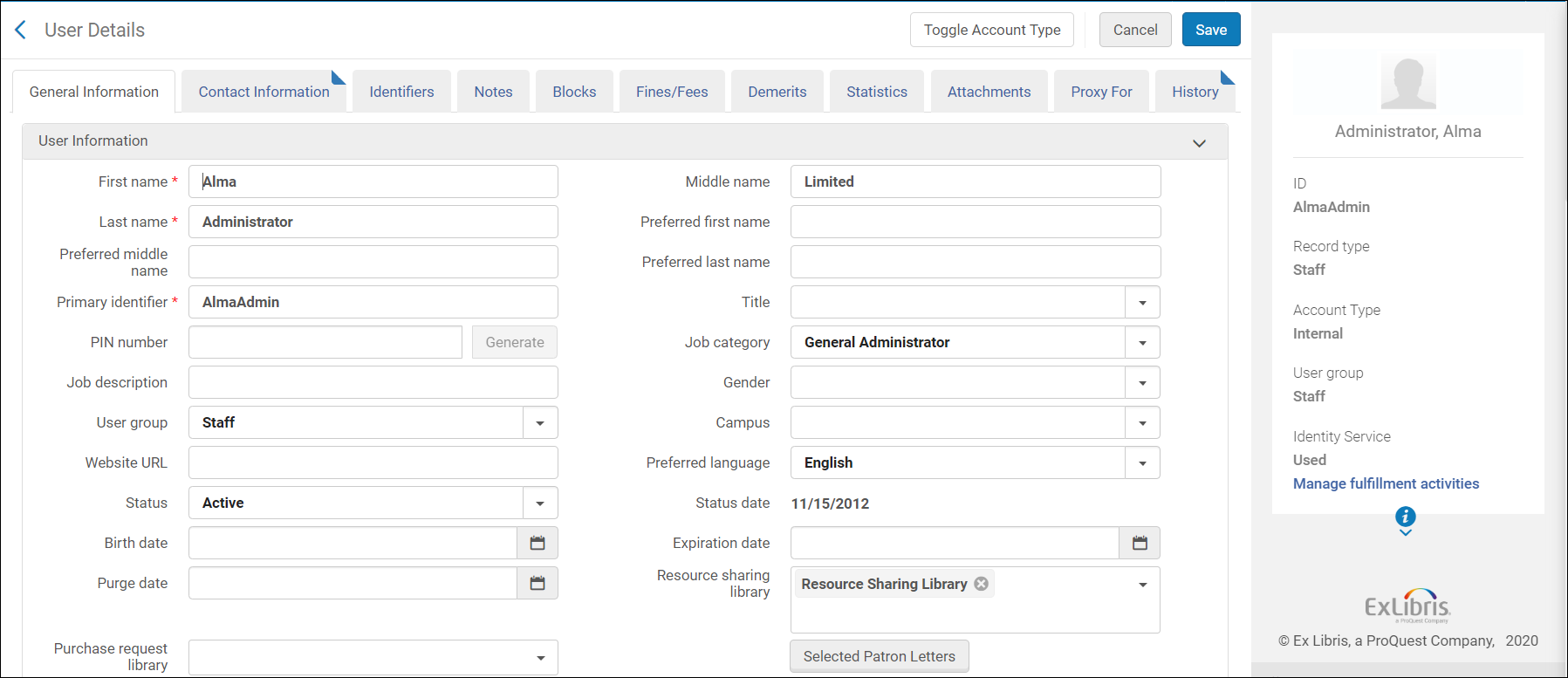
The field descriptions can be found in the User Details shared dimension.
- Many institutions store information about individuals, including personal details and information about their activities. Due to privacy concerns, some institutions are required to anonymize the data on a regular basis.
- Alma offers the option to delete such user information for fulfillment and resource sharing activities. The information is deleted for activities that have been completed, such as completed loans, closed fines and fees, or resource sharing borrowing requests.
- You can configure Alma to delete the more specific information (for example, User ID) and retain the more general user information (for example, User Group and Job Title).
- The information that is not anonymized can be included in Analytics reports.
- For more information concerning anonymization, see Security and Data Privacy.
| Field | Description | Additional Information | Data Type | Data Size |
|---|---|---|---|---|
| Creation Date | Stores the date that the user was created in the system | See the field location in Alma in the image below. | DATE | |
| Creator | Stores the user name of the user that created the user in the system | See the field location in Alma in the image below. | VARCHAR | 255 |
| Modification Date | Stores the date of the modification of the user record | See the field location in Alma in the image below. | DATE | |
| Modified By | Stores the name of the user that modified the user record | See the field location in Alma in the image below. | VARCHAR | 255 |
| Campus Code | Stores the campus code of the user | See the field location in Alma in the image below. | VARCHAR | 50 |
| Job Title | Stores the job category definition to which the user belongs based on the Job Categories code table | See the field location in Alma in the image below. | VARCHAR | 255 |
| Statistical Categories 01-10 | These fields allow you to map ten statistical categories. This allows you to filter reports based on advanced user information typically stored in the statistical category fields. For more information, see Configuring Statistical Categories. | VARCHAR | 4000 | |
| User Group | Stores the group with which the user is associated such as Faculty, Graduate, or Student | See the field location in Alma in the image below. | VARCHAR | 4000 |
| User Group Code | VARCHAR | 255 | ||
| User Type | Stores the values Internal and External. |
See the field location in Alma in the image below. |
CHAR | 20 |
| Birth Date | Stores the birth date of the user | See the field location in Alma in the image below. | DATE | |
| Cataloger Level | The cataloger level of the user. | VARCHAR | 255 | |
| Default Language | Stores the default language of the user | See the field location in Alma in the image below. | VARCHAR | 4000 |
| Disable All Login Restrictions | VARCHAR | 3 | ||
| Expiry Date | Stores the date on which the user is to expire and no longer be able to get service from the system |
See the field location in Alma in the image below. Changing the user expiry date is one way to control item due dates that extend beyond the end of a semester and must be shortened to the end of the semester. |
DATE | |
| External ID | Stores the ID of the user in the originating system | VARCHAR | 255 | |
| First Name | Stores the user’s first name | See the field location in Alma in the image below. | VARCHAR | 255 |
| Full Name | The user's first and last name | There is no option to include the middle name. | VARCHAR | 511 |
| Gender (Not in Use) | Possible values are taken from the Genders code table (Configuration > User Management > User Details > Genders) | See the field location in Alma in the image below. | VARCHAR | 4000 |
| Has Role Other Than Patron | Indicates if the patron has a role other than Patron | VARCHAR | 3 | |
| Has Role Other Than Patron and Instructor | Indicates if the patron has a role other than Patron and Instructor | VARCHAR | 3 | |
| Identifier 1 | Stores identifier 1 |
The identifier field allows you to enrich the user details exported to Analytics with additional identifiers. Selecting a specific identifier to be included in the user details is done in Alma (in a table that is currently restricted to Ex Libris staff). For assistance in defining this field, contact Ex Libris Support. Only one value per identifier is supported.
|
VARCHAR | 4000 |
| Identifier 2 | Stores identifier 2. See details for the Identifier 1 field above. | VARCHAR | 4000 | |
| Is Blocked | Indicates if the patron is blocked | VARCHAR | 3 | |
| Job Description | Stores free-form text that describes the function of the user in the library | See the field location in Alma in the image below. | VARCHAR | 255 |
| Last Activity Date | The last date that a patron made a request or borrowed or returned an item | DATE | ||
| Last Name | Stores the user’s last name | VARCHAR | 255 | |
| User – Linked From Institution Code | The code of the institution from which the user is linked | VARCHAR | 255 | |
| User – Linked From Institution Name | The name of the institution from which the user is linked | VARCHAR | 255 | |
| User – Linked From Other Institution | Indicates if the user is linked from another institution | Possible values: yes/no | VARCHAR | 4000 |
| Linked To Other Institution | Indicates if the user accessed Primo/Alma for services in another institution. Note that this does not necessarily indicate that the services were actually supplied or that a linked account was created. | Possible values: yes/no | VARCHAR | 10 |
| Middle Name | Stores the middle name of the user | See the field location in Alma in the image below. | VARCHAR | 255 |
| Patron Letters Opt In | The letters for which the patron has opted in | VARCHAR | 2000 | |
| Patron Letters Opt Out | The letters for which the patron has opted out | VARCHAR | 2000 | |
| Preferred First Name | Stores the user’s preferred first name | See the field location in Alma in the image below. | VARCHAR | 255 |
| Preferred Last Name | Stores the user’s preferred last name | See the field location in Alma in the image below. | VARCHAR | 255 |
| Preferred Middle Name | Stores the user's preferred middle name | See the field location in Alma in the image below. | VARCHAR | 255 |
| User Primary Identifier | Stores the primary identifier that the user uses in order to log on to Alma | See the field location in Alma in the image below. | VARCHAR | 255 |
| Purge Date | Stores the date on which the user record is to be deleted from Alma | See the field location in Alma in the image below. | DATE | |
| Resource Sharing Library | The resource sharing library assigned to the user. | VARCHAR | 4000 | |
| Resource Sharing Library Code | The code of the resource sharing library assigned to the user. | VARCHAR | 4000 | |
| User Status | Indicates if the user is active | See the field location in Alma in the image below. | VARCHAR | 8 |
| Status Date | Stores the date on which the patron was registered in the institution | See the field location in Alma in the image below. | DATE | |
| User ID | Stores the unique ID of the user | VARCHAR | 50 | |
| User Record Type | Indicates if the user is a Public User or a Staff User | See the field location in Alma in the image below. | VARCHAR | 4000 |
| User Title | The title of the user. | VARCHAR | 4000 |

Library Unit
The Library Unit table is a dimension table that displays details about the library where the borrowing request was created. The primary key of the table is LIBRARYID.
The field descriptions can be found in the Library Unit shared dimension.
| Field | Description | Field Location in Alma | Additional Information | Data Type | Data Size |
|---|---|---|---|---|---|
| Library Address Line 1 | The first line of the address of the institution. It usually includes the building number and the street name. |
Configuration > General > Add a Library or Edit Library Information > Contact Information tab. This is taken from the address configured as the Preferred address. The label in Alma is Address Line 1. |
VARCHAR | 1000 | |
| Library City | The city of the library. |
Configuration > General > Add a Library or Edit Library Information > Contact Information tab. This is taken from the address configured as the Preferred address. The label in Alma is City. |
VARCHAR | 255 | |
| Library Code | The library code | Configuration > General > Libraries > Add a Library or Edit Library Information > Libraries tab > Path [the text after the period] | VARCHAR | 50 | |
| Library Code (Active) | The code of active (not deleted) libraries | Configuration > General > Libraries > Add a Library or Edit Library Information > Libraries tab > Path [the text after the period] | The same as Library Code without deleted libraries. | VARCHAR | 50 |
| Library Country | The country of the library. |
Configuration > General > Add a Library or Edit Library Information > Contact Information tab. This is taken from the address configured as the Preferred address. The label in Alma is Country. |
VARCHAR | 320 | |
| Library Description | The library description |
Configuration > General > Libraries > Add a Library or Edit Library Information > Libraries tab The label in Alma is Description. |
VARCHAR | 100 | |
| Library Name | The library name |
Configuration > General > Libraries > Add a Library or Edit Library Information > Libraries tab The label in Alma is Organization Unit Name. |
VARCHAR | 255 | |
| Library Name (Active) | The library name of active (not deleted) libraries |
Configuration > General > Libraries > Add a Library or Edit Library Information > Libraries tab The label in Alma is Organization Unit Name. |
The same as Library Name without deleted libraries. | VARCHAR | 255 |
| Library Postal Code | The postal code of the library. |
Configuration > General > Add a Library or Edit Library Information > Contact Information tab. This is taken from the address configured as the Preferred address. The label in Alma is Postal code. |
VARCHAR | 200 | |
| Library State Province | The state or province of the library. |
Configuration > General > Add a Library or Edit Library Information > Contact Information tab. This is taken from the address configured as the Preferred address. The label in Alma is State/Province. |
VARCHAR | 320 | |
| Unit Type | The type of organization unit |
Configuration > General > Libraries > Add a Library or Edit Library Information > Libraries tab The label in Alma is Organization Unit Type. |
Values can be Institution/Library | VARCHAR | 20 |
Bibliographic Details
The Bibliographic Details table is a dimension table that displays the bibliographic details of the borrowing request item. The fields are from the MMS_DISPLAY table. The primary key of the table is MMS_ID.
The field descriptions can be found in the Bibliographic Details shared dimension.
Ex Libris works with content providers worldwide to enrich the metadata available in the Alma Community Zone. To enrich the journal/serial content in the CZ, we work directly with the Library of Congress CONSER feed for electronic serials, which we match against our knowledge base to enrich with all of the relevant metadata fields that they supply (for more details, see Community Zone Serial Records Enrichment) and enrich the CZ records with all relevant metadata, including the 050 fields (when available). In the case of book content, we work with multiple providers who are willing to share their metadata with the Alma community globally (for more details, see Community Zone Monograph Records Enrichment). If you have local access to these classifications, you may want to consider working with the local extension for these records whenever an update is not available. (For more details, see Working with Local Extension Fields for Community Zone-linked Records.)
The Bibliographic Details table contains two kinds of fields, those derived from the MARC record and those that come from Alma. Although in analytics there is no distinction made between these fields, for explanatory purposes we have divided them into two tables below.
The Bibliographic Details table includes all bibliographic records in the catalog whether they have inventory or not.
| Field | Note | Mapping from MARC21 | Mapping from UNIMARC | Mapping from Dublin Core | Data Type | Data Size |
|---|---|---|---|---|---|---|
| Action Note | A note that contains information about the retention and the retention reason of the bibliographic record. | 583 | Not relevant | Not relevant | VARCHAR | VARCHAR |
| Author | The term Author refers to the individual or group of individuals responsible for creating or producing the work being documented. The author is the primary contributor to the work, and their name is typically listed prominently in the bibliographic record to identify the originator of the content. Depending on the type of work and the citation style, the author's name may be followed by additional information such as their credentials, institutional affiliation, and the date of publication. | 100,110,111 | 700,701,710,711 | Currently empty, planned to come from dc:creator, dcterms:creators | VARCHAR | 4000 |
| Author (Contributor) | The Author (Contributor) role refers to the specific role or function played by an individual or group in the creation or production of a work. This role is important for cataloging and documenting the contributions of different individuals or entities to a particular resource. The Author (Contributor) role is a way to categorize and describe the responsibilities of contributors beyond just being the primary author. |
711 a,c-e,i,j,n,q,u and its 880 700 a-e,j,q,u and its 880 710 a-e,i,n,u and its 880 |
700 a-d,f,p 701 a-d,f,p 710 a-h,p 711 a-h,p 720 a,f" 721 a,f 702 a-d,f,g 712 a-h,p 722 a,f |
Currently empty, planned to come from dc:contributor, dcterms:contributor | VARCHAR | VARCHAR |
| Begin Publication Date | The Begin Publication Date refers to the earliest date associated with the publication or release of a particular work. It is a critical piece of information that helps users understand when the work was first made available to the public. The publication date can be essential for citing the work correctly, tracking its historical context, and assessing its relevance to specific time periods. | 008 pos. 07-10 | 100.Date1 | Not relevant for Dublin Core | VARCHAR | 255 |
| BIB 008 MARC | The contents of the MARC 008 bibliographic field. The BIB 008 field in a MARC bibliographic record is a fixed-length data element used to provide additional information about the bibliographic record itself. It contains various control information that helps catalogers and library systems manage and process the record. | 008 | Not relevant for Dublin Core | VARCHAR | 50 | |
| BIB LDR MARC | The BIB LDR refers to the Leader field (LDR) within the bibliographic record. The Leader is a fixed-length data element that provides control information about the bibliographic record itself. It is a critical component of MARC records, and each position within the Leader serves a specific purpose. The Leader field is typically 24 characters in length. The Leader field is used to convey fundamental information about the structure, organization, and characteristics of the bibliographic record. | LDR | Not relevant for Dublin Core | VARCHAR | 50 | |
| Bibliographic Acquisition Accession Number Note | The identification code assigned to materials acquired in a single and separate transfer of custody. | 541 e | Not relevant for Dublin Core | VARCHAR | 255 | |
| Bibliographic ID | A Bibliographic ID is a unique identifier assigned to a specific bibliographic entry or resource. It serves as a way to distinguish and locate a particular work within a library's catalog or database. The purpose of a bibliographic ID is to facilitate efficient retrieval and management of bibliographic records and to ensure that each record is distinct. | 010 excluding numeric subfields | 020 a | dcterms:identifier dcterms:ISBN, dcterms:identifier dcterms:ISSN | VARCHAR | 255 |
| Bibliographic Level | The Bibliographic Level is a classification that describes the scope and content of a bibliographic record. It helps users understand the nature of the resource being described in the record. The bibliographic level is often indicated using a one-letter code or abbreviation. Common bibliographic levels include: Monograph (m), Serial (s), Collection (c), Integration (i), Monographic Series (a), and so forth. | Position 7 of the LDR field of the bibliographic record | Position 7 of the LDR field of the bibliographic record | Not relevant for Dublin Core | VARCHAR | 255 |
|
Bibliographic Lifecycle
|
The Lifecycle of the bibliographic record. Possible values are Deleted and In Repository. This allows you to filter reports and to remove Deleted records.
|
|
|
|
VARCHAR
|
50 |
|
Bibliographic Rank
|
Alma assesses the comprehensiveness and depth of MARC 21 bibliographic entries, considering various elements such as identifiers, names, subjects, informative LDR and 008 fields, publication details, among others. This evaluation is reflected in the Bibliographic Rank, designed as a useful aid for libraries in pinpointing records requiring further scrutiny. For more information, see here.
|
|
|
|
INT
|
|
| Bibliographic Record Label | Displays the labels associated with the bibliographic record. When multiple labels are assigned, the label values are concatenated together with a semicolon (;). | VARCHAR | 4000 | |||
| Bibliographic Source of Acquisition Note | The name of the people or organization that is the source of the material. | 541 a | Not relevant for Dublin Core | VARCHAR | 255 | |
| Category of Material | The Category of Material is a classification or designation that describes the format or physical nature of the material being cataloged. It helps users and catalogers understand the medium in which a resource is presented. | Position 0 of the 007 field | 200 b | Not relevant for Dublin Core | VARCHAR | 255 |
| DC Coverage | DC Coverage refers to an element used to provide information about the spatial or temporal topic of the resource, spatial applicability of the resource, or jurisdiction under which the resource is relevant. | Relevant only for Dublin Core | Relevant only for Dublin Core | dc:coverage dcterms:coverage dcterms:spatial dcterms:temporal | VARCHAR | |
| DC Description | DC Description refers to Dublin Core (DC) metadata elements used to describe resources in a standardized way, particularly in digital libraries and online cataloging systems. | Relevant only for Dublin Core | Relevant only for Dublin Core | dc:description dcterms:description dcterms:abstract | VARCHAR | 4000 |
| DC Format | The file format, physical medium, or dimensions of the resource. The information in this field is entered as free text. | Relevant only for Dublin Core | Relevant only for Dublin Core | dc:format dcterms:format | VARCHAR | 256 |
| DC License | DC License is a Dublin Core element used to specify the terms and conditions associated with the use of a resource. It provides information about the licensing or copyright status of a digital or physical resource, allowing users to understand how they can legally use, share, or redistribute the resource. The DC License element is particularly important in digital libraries, repositories, and online cataloging systems where access to digital content is provided. | Relevant only for Dublin Core | Relevant only for Dublin Core | It will be populated by dcterms:license | VARCHAR | 4000 |
| DC Provenance | DC Provenance refers to an element used to provide a statement of any changes in ownership and custody of the resource since its creation that are significant for its authenticity, integrity, and interpretation | Relevant only for Dublin Core | Relevant only for Dublin Core | dcterms:provenance | VARCHAR | 4000 |
| DC Relation | DC Relation refers to an element used to provide information about a related resource to the described resource. | Relevant only for Dublin Core | Relevant only for Dublin Core | dc:relation dcterms:relation dcterms:isVersionOf dcterms:hasVersion dcterms:isReplacedBy dcterms:replaces dcterms:isRequiredBy dcterms:requires dcterms:isPartOf dcterms:hasPart dcterms:isReferencedBy dcterms:references dcterms:isFormatOf dcterms:hasFormat dcterms:conformsTo | VARCHAR | 4000 |
| DC Rights | DC Rights refers to an element used to provide information about the intellectual property rights or copyright status of a resource. This element helps users understand the legal rights and permissions associated with the resource and whether there are any restrictions on its use. | Relevant only for Dublin Core | Relevant only for Dublin Core |
dc:rights and dcterms:rights |
VARCHAR | 4000 |
| DC Source | DC Source refers to an element used to provide information about a related resource from which the described resource is derived. | Relevant only for Dublin Core | Relevant only for Dublin Core |
dc:source dcterms:source |
VARCHAR | 4000 |
| DC Type | DC Type refers to an element used to provide information about the nature or genre of the resource. | Relevant only for Dublin Core | Relevant only for Dublin Core |
dc:type dcterms:type |
VARCHAR | 255 |
| Edition | Edition refers to a specific version or variation of a publication. The edition information provides details about changes, updates, or variations that have occurred since the original publication. Including the edition helps users and researchers identify the specific version of a book or other resource they are looking for. | 250 subfields a,b | 205 a,b,f,g | dcterms:isVersionOf | VARCHAR | 255 |
| Electronic location and access | The location and access URl for the electronic resource. | 856 all subfields | 856 all subfields | Not relevant for Dublin Core | VARCHAR | 4000 |
| End Publication Date | The End Publication Date is the second date available in the 008 field, and it is used to indicate "Date 2." It is described as "A date specified by the code in 008/06 (Type of date/Publication status)." | 008 pos. 11-14 | 100.Date2 | Not relevant for Dublin Core | VARCHAR | 255 |
| Enriched with AI | Indicates that the bibliographic record of the resource was enriched by the AI Asisstant. | VARCHAR | 4 | |||
| Form of Item | The Form of Item refers to a specific code or indicator that describes the physical format or medium of the resource being cataloged. This information helps library users understand the physical characteristics of the item and whether it is in a print or non-print format. | 008 pos. 29 (Maps and Visual Material) or 23 (other material configurations) | Not relevant for Dublin Core | VARCHAR | 1 | |
| General Note | A General Note is a field used to provide additional information or commentary about the resource being described. General notes can include various types of information that may not fit into specific structured fields within the bibliographic record. These notes are often used to convey contextual details, historical significance, or other relevant information about the resource. | 500 a, 5 | 300 a | Not relevant for Dublin Core | VARCHAR | 4000 |
| Government Publication | A Government Publication is a term used to identify materials that are published or produced by government entities at various levels of government, including federal, state, local, and international governments. For more information regarding the values of MARC 008 Pos. 28, see here. |
008 pos. 28 According to MARC21 Format for Bibliographic Data, 008 pos. 28 is Government Publication for the following material types: Books, Computer Files, Continuing Resources, Maps, and Visual Materials.For Music 008 pos. 28 is Accompanying matter. For Mixed material 008 pos. 28 is Undefined.Consequently, when using this field, you may want to filter out records with Material Type = Music and Material Type = Mixed material. |
Not relevant for Dublin Core | VARCHAR | 1 | |
| ISBN | ISBN is a unique identifier for books, and it is used to facilitate the identification and cataloging of books and related materials. Field in analytics includes also cancelled and invalid ISBNs. | 020 a, z 776 z | 010 a | dcterms:identifier dcterms:ISBN | VARCHAR | 255 |
| ISBN Valid | A unique identifier for books and related materials. To be considered valid, an ISBN must adhere to the established ISBN standards and conventions. Field in analytics does not include cancelled and invalid ISBNs. | 020 a | Not relevant for Dublin Core | VARCHAR | 255 | |
| ISSN | An ISSN (International Standard Serial Number) is a unique identifier for serial publications, which include periodicals, journals, magazines, and other recurring publications. Field in analytics includes also cancelled and invalid ISSNs. | 022 l,a 776 x (for non-physical records) | 011 a f | dcterms:identifier dcterms:ISSN | VARCHAR | 255 |
| ISSN Valid | A unique identifier for serial publications. To be considered valid for bibliographic records, an ISSN must adhere to the established standards and conventions for ISSN formatting and structure. Field in analytics does not include cancelled and invalid ISBNs. | 022 a | Not relevant for Dublin Core | VARCHAR | 255 | |
| Language Code | Language codes are used to indicate the language(s) in which a particular resource is written or presented. Language codes are typically standardized to ensure consistency in cataloging and bibliographic records. | 008 pos. 35-37 | 101 a | Currently comes from dc:language. Planned to come from dc:language and dcterms:language | VARCHAR | 255 |
| Language Of Cataloging | The Language of Cataloging refers to the language in which the cataloging or metadata for a particular resource is created. | 040 b | 100 a,22-24 | Not relevant for Dublin Core (Value None is displayed) | VARCHAR | 4000 |
| Local Note | A Local Note is a type of note that provides specific information or instructions related to a library's unique policies, holdings, or services. Local notes are typically used to convey information that is specific to the individual library or cataloging institution and may not be relevant to libraries elsewhere. For Borrowing Requests, the Source is stored in this field. | 590 a, 5 | Not relevant for Dublin Core | VARCHAR | 4000 | |
| Material Type | See the table, Fields that Identify the Bibliographic Material Type, in the Material Types in Search Results section for a description of material type. | MARC control LDR Material Type | Planned to be empty. Currently comes from dc:type This field holds a fixed set of values designated for all record formats. For DC, the mapping is controlled from Configuration Resources > Cataloging > DCMI Material Type Mapping page. Any dc:type value not defined on this pages gets by default the value Computer File. For more information, see DCMI Material Type Mapping. | VARCHAR | 4000 | |
| Material Type Code | Code of the material type described above (in Material Type). | MARC control LDR Material Type | Not relevant for Dublin Core | VARCHAR | 255 | |
| National Agricultural Library Call Number | The call number used by the American National Agricultural Library. | 070 a | Not relevant for Dublin Core | |||
| Network Number | A Network Number typically refers to a unique identifier assigned to a bibliographic record within a library network or consortium. | 035 a z | 053 a z |
dc:identifier , dcterms:identifier |
VARCHAR | 4000 |
| OCLC Control Number (019) | The OCLC Control Number (019 field) is used by OCLC to record and index OCLC control numbers of records that have been deleted or will be processed as duplicate records. For more information on the OCLC Control Number 019 and its subfields, see here. Leading zeros are not displayed. |
019 a When the subfield begins with one of the following prefixes:
|
Not relevant for Dublin Core | VARCHAR | 4000 | |
| OCLC Control Number (035a) | Subfield "a" in the 035 field is used to record the main OCLC Control Numbers. For more information on the OCLC Control Number 035 and its subfields, see here. Leading zeros are not displayed. |
035 a When the subfield begins with one of the following prefixes:
|
035 a | Not relevant for Dublin Core | VARCHAR | 4000 |
| OCLC Control Number (035a+z) | The OCLC Control Number can include both the main OCLC Control Number in subfield "a" and any related or canceled OCLC Control Numbers in subfield "z." This practice is useful for indicating changes or updates to cataloging records and for maintaining a historical record of previous control numbers associated with the same resource. For more information on the OCLC Control Number 035 and its subfields, see here. Leading zeros are not displayed. |
035a+z When the subfield begins with one of the following prefixes:
|
035a+z | Not relevant for Dublin Core | VARCHAR | 4000 |
| OCLC Control Number (035z) | Subfield "z" in the 035 field is used to record related or canceled OCLC Control Numbers, providing a historical record of control numbers associated with a specific resource. For more information on the OCLC Control Number 035 and its subfields, see here. Leading zeros are not displayed. |
035 z When the subfield begins with one of the following prefixes:
|
035 z | Not relevant for Dublin Core | VARCHAR | 4000 |
| Open Access | Open Access (OA) refers to a publishing model that provides unrestricted and free access to scholarly and research publications on the Internet. It signifies that the full text or content of the publication is freely available to anyone, without requiring payment or subscription. Values are Yes and No. | Based on 506 f 506 2 | Not relevant for Dublin Core | VARCHAR | 4 | |
| Original Cataloging Agency | The MARC code or the name of the organization that created the original record. | 040 a | 081 b | Not relevant for Dublin Core | VARCHAR | 255 |
| Place Code | The Place Code is a code that represents the place of publication for a printed or published resource. | 008 pos. 15-17 | 102$$a | dcterms:spatial | VARCHAR | 50 |
| Place of Publication - City | The city where a printed or published resource was published or produced. |
Derived from the place code in 008 pos. 15-17. If the value of this field in the bibliographic record does not exist in the official list of place codes, the value for this field in Alma Analytics will be "No place, unknown, or undetermined". |
Not relevant for UNIMARC | Not relevant for Dublin Core | VARCHAR | 200 |
| Place of Publication - Country | The country where a printed or published resource was published or produced. |
Derived from the place code in 008 pos. 15-17. For a list of country codes, see: MARC Code List for Countries If the value of this field in the bibliographic record does not exist in the official list of place codes, the value for this field in Alma Analytics will be "No place, unknown, or undetermined". |
Derived from the place code 102$$a. For a list of country codes, see: List of ISO 3166 Country Codes If the value of this field in the bibliographic record does not exist in the official list of place codes, the value for this field in Alma Analytics will be "No place, unknown, or undetermined". If there are multiple place codes in this field, only the first value is displayed. |
Not relevant for Dublin Core. Value No place, unknown, or undetermined is displayed) | VARCHAR | 200 |
| Place of Publication - State | The state where a printed or published resource was published or produced. | Derived from the place code in 008 pos. 15-17. If the value of this field in the bibliographic record does not exist in the official list of place codes, the value for this field in Alma Analytics will be "No place, unknown, or undetermined". | Not relevant for UNIMARC | Not relevant for Dublin Core | VARCHAR | 200 |
| Publication Date | The Publication Date refers to the date when a printed or published resource was officially issued, published, or made publicly available. |
The publication date is determined as follows:
|
The publication date is determined as follows:
|
dc:date, dcterms:date, dcterms:created, dcterms:available, dctrems:issued, dcterms:dateAccepted | VARCHAR | 255 |
| Publication Place | The Publication Place refers to the city or location where a printed or published resource was officially published, issued, or produced. | 260 a. When 260 a is empty, it is taken from 264 a | 210 a 214 a | Not relevant for Dublin Core (use Place Code) | VARCHAR | 255 |
| Publisher | The Publisher refers to the entity or organization responsible for producing, printing, and distributing a printed or published resource. |
260 b 264 b |
210 c 214 c |
dcterms:publisher, dc:publisher |
VARCHAR | 255 |
| Resource Type | Constructed based on existing bibliographic fields such as the LDR and 008. For more information, see The Resource Type Field. | Not relevant for Dublin Core | VARCHAR | 4000 | ||
| Series | A Series refers to a related group of publications or resources that share common characteristics, themes, or subjects and are published under a common title or series name. |
800 t,v 810 t,v 811 t,v 830 a,n,p,v |
410 a,h,i,o,t,x | dcterms:isPartOf | VARCHAR | 4000 |
| Series Statement | A Series Statement refers to the title or name of a series to which a printed or published resource belongs. | 490 a,v,x | 225 a,v,x | Not relevant for Dublin Core | VARCHAR | 4000 |
| Source of Description Note | A note used by the Community Zone with details on AI enrichment. | 588 $$a | Not relevant | Not relevant for Dublin Core | VARCHAR | 1000 |
| Subjects | Subjects refer to the specific topics, themes, or subjects covered by a printed or published resource. | 6XX excluding 69X, 630, 689 | 600 a,b 602 603-8 610 616 617 | dc:subject dcterms:LCSH,MESH,DDC,UDC,LCC | VARCHAR | 4000 |
| Subjects (Names) | Subjects (Names) refers to the specific individuals, organizations, or entities associated with a printed or published resource. |
600 a,b,c,d,e,l,t.u 610 a,b,c,d,e,l,n,t,u 611 a,b,c,d,e,j,l,n,q,t,u |
600 a,b,c,d,f,t (obsolete),p 601 a,b,c,d,e,f,t (obsolete) 601 a,b,c,d,e,f,t (obsolete) |
Not relevant for Dublin Core | VARCHAR | 4000 |
| Title | The Title refers to the name or title of a printed or published resource. The title is one of the most critical elements of bibliographic cataloging because it helps users identify and distinguish one resource from another. |
245 a,b 249 a,b,c,v |
200 a,c,d,e,h,i | dc:title | VARCHAR | 4000 |
| Title (Complete) | The information from MARC field 245, subfields $a, $n, $p, $h, $b, $c, $f, $g, $k, $s. | 245 a,n,p,h,b,c,f,g,k,s | 200 a-i | dc:title, dcterms:title, dc:alternative | VARCHAR | 4000 |
| Title (Filing) |
The title with common words such as "The" and "An" removed to help with sorting the title alphabetically. Any text between double arrows (<<>>) is removed. For a video describing the use of this field, see Sort Analytics Reports by Filing Title - Ignoring "The", "A", and "An". |
240 a,c,p 245 a,c,p |
200 a,e 500 |
Not relevant for Dublin Core | VARCHAR | 4000 |
| Title (Normalized) |
The normalized Title. This field is useful when you want to compare titles that may have been catalogued differently. This field is built in the following manner: Alma does the following to the 245 field (except subfields c,h,6 and 8) in the following order:
|
245 a,b,n,p 249 a,b,c,v |
200 a,c,d,e,h,i | dc:title | 4000 | |
| Title Author Combined and Normalized | 100 characters of the normalized title and the first four letters of the author in lowercase letters, with spaces removed. | See Author and Title Fields | See Author and Title Fields | See Author and Title Fields | VARCHAR | 110 |
| Title Committed to Retain |
Title Committed to Retain refers to a commitment made by a library to retain and preserve a specific resource. This commitment is important for ensuring the long-term availability and accessibility of important scholarly or historical materials. Indicates (Yes/No) if the bibliographic record is marked as Committed to Retain. |
Configurable from Configuration > Resources > Collection Retention > Bibliographic Collection Retention Definition. For more information, see Bibliographic Record Retention. | Not relevant for Dublin Core | VARCHAR | 4 | |
| Type of date | The Type of Date refers to the nature or purpose of a date included in the record. It specifies what the date represents or signifies within the bibliographic context. The type of date can provide important information to users and catalogers about the significance of the date included in the record. |
008 pos. 6 For more information on the options available for Type of date in 008 pos. 6, see here. |
100 pos 8 | Not relevant for Dublin Core | VARCHAR | 255 |
| Uniform Resource Identifier | A Uniform Resource Identifier (URI) is a string of characters used to identify a resource on the internet or within a particular system. URIs are often used to provide direct links or references to online resources related to the bibliographic entry, such as a digital version of a book, an electronic journal article, or additional related materials. | 856 u | 856 u |
dc:identifier (dcterms:URI) ,dcterms:identifier (dcterms:URI) |
VARCHAR | 4000 |
| Uniform Resource Identifier Field Exists |
Indicates whether a Uniform Resource Identifier (URI) Exists for the bibliographic record. Values are 0 or 1, where "0" means No and "1" means Yes. Indicates if 856 subfield u contains data. |
Not relevant for Dublin Core | INT | |||
| Uniform Title | A Uniform Title is a standardized title used to represent a specific work, especially when that work has been published under multiple titles or in various editions, languages, or formats. | 240 130 |
500 The Uniform Title is only mapped if the first indicator = 1. If the first indicator for UNIMARC 500 is empty or 0, the value is not mapped to Analytics. |
Not relevant for Dublin Core | VARCHAR | 4000 |
The following table describes other fields in the shared dimension (taken from Alma and not MARC):
| Field | Description | Data Type | Data Size |
|---|---|---|---|
| Active Course Code | Active Course Code is the code of the course in the Alma course reserves. For more information see here. | VARCHAR | 4000 |
| Active Course Name | Active Course Name is the name of the course in the Alma course reserves. For more information see here. | VARCHAR | 4000 |
| Bibliographic Lifecycle | The Lifecycle of the bibliographic record. Possible values are Deleted and In Repository. This allows you to filter reports and to remove Deleted records. | VARCHAR | 50 |
| Bibliographic Rank | Alma assesses the comprehensiveness and depth of MARC 21 bibliographic entries, considering various elements such as identifiers, names, subjects, informative LDR and 008 fields, publication details, among others. This evaluation is reflected in the Bibliographic Rank, designed as a useful aid for libraries in pinpointing records requiring further scrutiny. For more information, see here. | INT | |
| Brief Level | Brief Level refers to the level of detail provided in a bibliographic description. It indicates how much information is included in the bibliographic record, with brief descriptions containing less detailed information compared to full or comprehensive descriptions. In Alma, ten levels of brief records can be defined from 01 through 10, where 01 represents the most brief record and 10 represents a full record. For more information see here. | VARCHAR | 2 |
| Chinese Classification | The Chinese Classification of the bibliographic record. For more information, see here. | VARCHAR | 50 |
| Collection ID |
The ID of the collection or collections the bibliographic record is associated with as defined at Resources > Manage Inventory > Manage Collections. Relevant only for bibliographic records that are part of a collection. One MMS_ID can be attributed to multiple titles collections, therefore a delimited list of collections are defined for the MMS. |
VARCHAR | 4000 |
| Collection Name |
The Name of the collection or collections the bibliographic record is associated with as defined at Resources > Manage Inventory > Manage Collections. Relevant only for bibliographic records that are part of a collection. |
VARCHAR | 4000 |
| Created with AI | Indicates that the bibliographic record of the resource was created by the AI Assistant. | VARCHAR | 4 |
| Creation Date | The timestamp of the bibliographic record creation date. | DATETIME | |
| Creation Date (Calendar) | The creation date without a timestamp. This date format is useful when filtering the report by date. | DATE | |
| Creator | The name of the user that created the record | VARCHAR | 255 |
| Dewey Classification | The Dewey classification of the record. | VARCHAR | 255 |
| Dewey Classification Top Line | The first 3 digits of the Dewey Classification | VARCHAR | 15 |
| Earliest Possible Publication Year |
A normalized version of the publication date to the earliest possible value when the exact date is not known. It is taken from MARC21 008 pos. 07-10 or UNIMARC 100.Date1. This field is normalized with all non-numeric characters converted to 0s. Values below 1500 and over 6000 will have the value 1. |
VARCHAR | 255 |
| Edition Simplified (Combined) | The values of the Edition Simplified (Num) and Edition Simplified (Text) fields. | VARCHAR | 255 |
| Edition Simplified (Num) | The number of the edition found in the MARC 250 field, simplified. | VARCHAR | 255 |
| Edition Simplified (Text) | The text of the edition found in the MARC 250 field, simplified. | VARCHAR | 255 |
| Export to Libraries Australia |
Indicates whether the record is published to Libraries Australia. This field appears only when the Customer Parameter national_catalog is defined. The field name is as defined in the parameter. Possible values:
|
VARCHAR | 255 |
| Export to WorldCat |
Indicates that publication status is applied to a record. Possible values:
|
VARCHAR | 255 |
| Has Local Extensions | Indicates if the Community Zone-linked record has local extensions (Y/N). | VARCHAR | 3 |
| ISBN (Normalized) | An ISBN that has been formatted or standardized according to established rules or conventions. | VARCHAR | 255 |
| ISSN (Normalized) | An ISSN that has been formatted or standardized according to established rules or conventions. | VARCHAR | 255 |
| Language Description | The language name of the title, based on the Language Code field on the record. | VARCHAR | 255 |
| LC Classification Top Line |
The combined LC code and classification call numbers until the first period which is followed by a letter. If there are no periods then the entire string is taken until there is a space. The length is limited to 50 characters. For example:
The LC Classification Top Line will contain one value. For MARC21, if the bibliographic record has:
Recent data may not be available if it has not yet been received from CONSER. |
VARCHAR | 50 |
| Link ID | The link ID, if the record is linked to the Community Zone or Network Zone. For more information concerning this field and the next two, see Understanding the fields Link ID Linked to CZ and Linked to NZ in the Bibliographic Details folder. | VARCHAR | 50 |
| Linked to CZ | Indicates if the record is linked to the Community Zone. | VARCHAR | 3 |
| Linked to NZ | Indicates if the record is linked to the Network Zone. | VARCHAR | 3 |
| Local Param 1-30 |
These fields of information are from MARC fields in Alma, which were configured specifically for your institution. All MARC fields other than control fields can be added as local parameters. Accordingly, MARC fields from 010 to 999 can be mapped to local parameters, including indicators. It is possible to define and select specific subfields for export, rather than including all subfields by default. You can define:
To utilize these fields, it is necessary to contact Ex Libris Support and provide them with the three-digit MARC field codes, as well as any specific subfields or indicators you would like included. |
VARCHAR | 4000 |
| Managed by Provider |
Indicates if the electronic resource is managed by the provider. Possible values are Yes or No. Relevant only for electronic resources. |
VARCHAR | 3 |
| MMS ID | The MMS ID of the inventory item (physical, electronic, or digital). | VARCHAR | 255 |
| Modification Date | The latest (most recent) timestamp of the bibliographic record modification date. | DATETIME | |
| Modification Date (Calendar) | The latest (most recent) modification date without a timestamp. This date format is useful when filtering the report by date. | DATE | |
| Modified By | The name of the user that modified the record. | VARCHAR | 255 |
| Network ID | This field is used by institutions implementing a Network Zone. It is the same as the MMS ID of the bibliographic record in the Network Zone and can be used to create reports that show the MMS ID in the member institution (using the existing MMS ID), as well as the corresponding MMS ID in the Network Zone. | VARCHAR | 50 |
| Originating System |
The system where the bibliographic record originated. If Unknown is displayed in this field, see the following document: How to set up Alma so that the “Originating System” in Analytics will be properly populated. |
VARCHAR | 4000 |
| Originating System ID | The Originating System Version is the metadata record field that enables uploading records in the correct sequence by preventing the update of an existing record with an older version of the same record. This prevents older bibliographic records from overlaying or merging with newer records. The Originating System Version field is created from the record’s 005 control field the first time the record is imported. For information regarding normalizing the Originating System Version field, see the Update originating system information process and the procedure To configure normalization for managing the Originating System and Originating System Version information. | VARCHAR | 16 |
| Peer Reviewed | Indicates if the article was peer reviewed. | VARCHAR | 4 |
| Preservation Status |
The preservation status of the title in Rosetta Plus/Pro. Possible values:
|
VARCHAR | 255 |
| Provider Name | The name of the provider who manages the bibliographic record that is included in the CZ (Community Zone). Relevant only for electronic titles that are linked to the CZ and when an external provider manages the CZ record. | VARCHAR | 255 |
| Record Format |
The format of the bibliographic record. Examples:
|
VARCHAR | 4000 |
| Suppressed from Discovery | Indicates whether the record is suppressed from external discovery systems. | VARCHAR | 3 |
Assigned To
The Assigned To table is a dimension table that displays details about the user details of the staff member to whom the request is assigned.
| Field | Description | Field Location in Alma | Additional Information | Data Type | Data Size |
|---|---|---|---|---|---|
| User Record Type | The user record type |
Admin > Manage Users > Edit User > Right hand pane. The Alma label is Record type |
The possible values are:
See Managing User. |
VARCHAR | 4000 |
| Campus Code | The campus code of the user | Only campus name is displayed in the Users UI. | The full list of campus codes and names can be found in Configuration > General > Libraries > Define Campuses. | VARCHAR | 50 |
| External ID | The external ID in the user record (in the case where the record was created by an external system). | Not displayed in the UI. | For more information, see Managing User Identifiers. | VARCHAR | 255 |
| First Name | The first name in the user record. |
Admin > Manage Users > Edit User > General Information Tab > User Information Section. The Alma label is First name. |
VARCHAR | 255 | |
| Full Name | The full name in the user record. | Not displayed in the UI | Concatenation of the last name + first name. | VARCHAR | 511 |
| Gender (Not in Use) | The gender in the user record. |
Admin > Manage Users > Edit User > General Information Tab > User Information Section. The Alma label is Gender. |
Can be configured in Configuration > User Management > User Details > Genders. | VARCHAR | 4000 |
| Job Description | The job description in the user record. |
Admin > Manage Users > Edit User > General Information Tab > User Information Section. The Alma label is Job description. |
|||
| Job Title | The job category definition to which the user belongs based on the Job Categories code table | VARCHAR | 255 | ||
| Last Activity Date | The last activity date in the user record. This refers to the last date that the approver made a request or borrowed or returned an item. |
Admin > Manage Users > Edit User > General Information Tab > User Information Section. The Alma label is Last Patron Activity Date. |
This only displays if enabled at Configuration Menu > User Management > General > Record Last Patron Activity Date. For more information see Configuring Last Patron Activity Date. | DATE | |
| Last name | The last name in the user record. |
Admin > Manage Users > Edit User > General Information Tab > User Information Section. The Alma label is Last name. |
VARCHAR | 255 | |
| Middle Name | The middle name in the user record. |
Admin > Manage Users > Edit User > General Information Tab > User Information Section. The Alma label is Middle Name. |
VARCHAR | 255 | |
| Preferred First Name | The preferred first name in the user record. |
Admin > Manage Users > Edit User > General Information Tab > User Information Section. The Alma label is Preferred first name. |
VARCHAR | 255 | |
| Preferred Last Name | The preferred last name in the user record. |
Admin > Manage Users > Edit User > General Information Tab > User Information Section. The Alma label is Preferred last name. |
VARCHAR | 255 | |
| Preferred Middle Name | The preferred middle name in the user record. |
Admin > Manage Users > Edit User > General Information Tab > User Information Section. The Alma label is Preferred middle name. |
VARCHAR | 255 | |
| Primary Identifier | The primary identifier in the user record. |
Admin > Manage Users > Edit User > General Information Tab > User Information Section. The Alma label is Primary identifier. |
VARCHAR | 255 | |
| Status | The status in the user record. |
Admin > Manage Users > Edit User > General Information Tab > User Information Section. The Alma label is Status. |
The possible values are: Active Inactive For more information see the Find and Manage Users Page - Column Descriptions table in Managing Users. | VARCHAR | 8 |
| User Group | The user group in the user record. |
Admin > Manage Users > Edit User > General Information Tab > User Information Section. The Alma label is User group. |
User groups assigned to users can be configured by the institution. For more information see Configuring User Groups. | VARCHAR | 4000 |
| User ID | The Alma internal user ID in the user record. | Not displayed in the UI. | VARCHAR | 50 | |
| User Record Type | Indicates if the user is a Public User or a Staff User | VARCHAR | |||
| User Title | The user title in the user record. |
Admin > Manage Users > Edit User > General Information Tab > User Information Section. The Alma label is Title. |
For more information see Configuring User Titles. | VARCHAR | |
| User Type | The user type in the user record. | Admin > Manage Users > Edit User > Right hand pane. The Alma label is Account type. |
The possible values are:
For more information see User Management. |
CHAR |
Institution
The shared Institution dimension allows the Network Zone to view reports according to institution. If an analytics report is run from the Network Zone in a collaborative network implementing a Network Zone, all member institutions are included in the report for Institution Code and Institution Name. If an analytics report is run from an institution that is not part of a collaborative network implementing a Network Zone, only the single institution from which the report is run is included in the report for Institution Code and Institution Name.
This dimension is available in every subject area. It contains the following fields:
| Field | Description | Additional Information | Data Type | Data Size |
|---|---|---|---|---|
| Institution Code | The code of the institution. |
Configured from: Configuration > General > Add a Library or Edit Library Information > Summary tab. The label in Alma is Code located on the right pane. |
VARCHAR | 50 |
| Institution Name | The name of the institution. |
Configured from: Configuration > General > Add a Library or Edit Library Information > Summary tab. The label in Alma is Organization unit name. |
VARCHAR | 255 |
| Institution Address Line 1 | The first line of the address of the institution. It usually includes the building number and the street name. |
Configured from: Configuration > General > Add a Library or Edit Library Information > Contact Information tab. This is taken from the address configured as the Preferred address. The label in Alma is Address Line 1. |
VARCHAR | 1000 |
| Institution City | The city of the institution. |
Configured from: Configuration > General > Add a Library or Edit Library Information > Contact Information tab. This is taken from the address configured as the Preferred address. The label in Alma is City. |
VARCHAR | 255 |
| Institution State Province | The state or province of the institution. |
Configured from: Configuration > General > Add a Library or Edit Library Information > Contact Information tab. This is taken from the address configured as the Preferred address. The label in Alma is State/Province. |
VARCHAR | 320 |
| Institution Country | The country of the institution. |
Configured from: Configuration > General > Add a Library or Edit Library Information > Contact Information tab. This is taken from the address configured as the Preferred address. The label in Alma is Country. |
VARCHAR | 320 |
| Institution Postal Code | The postal code of the institution. |
Configured from: Configuration > General > Add a Library or Edit Library Information > Contact Information tab. This is taken from the address configured as the Preferred address. The label in Alma is Postal code. |
VARCHAR | 200 |
| Institution Timezone | The timezone of the institution. | The timezone is set during implementation. | VARCHAR | 255 |
| Data Available As Of | When the institution data became available in analytics. | Displayed at the bottom of the main Analytics menu. | VARCHAR | 255 |
| Data Updated As Of | When the institution data was taken from the Alma database. | Displayed at the bottom of the main Analytics menu. | VARCHAR | 255 |
Shared Dimensions with Other Subject Areas
For information concerning shared dimensions with other subject areas, see Shared Dimensions.
Page tags: article:topicInstitutionproduct:almacontent:Documentationlang:englishDue DateBibliographic DetailsLibrary UnitBorrowing Request DetailsBorrowing Creation DatePartnerRequester
